TMU — Transaction Monitoring Unit
1 · What is TMU?
Millions of transactions move through a bank every day. Most are ordinary. Some are criminals moving dirty money through accounts to make it look clean.
Anti-money laundering — AML — is how banks catch that. Emirates NBD's Transaction Monitoring Unit does it: every day they receive a list of cases the bank's system has flagged, and they decide whether each one is genuinely suspicious or a false alarm.
Banks in the UAE are legally required to do this. Get it wrong and there are heavy fines and licence risk. Get it wrong at scale and you're moving money for people trafficking drugs and worse.
2 · The problem
Every team in the chain was chasing the same outcome in a different tool. Investigators in one system, the reporting team in another, the MLRO in a third.
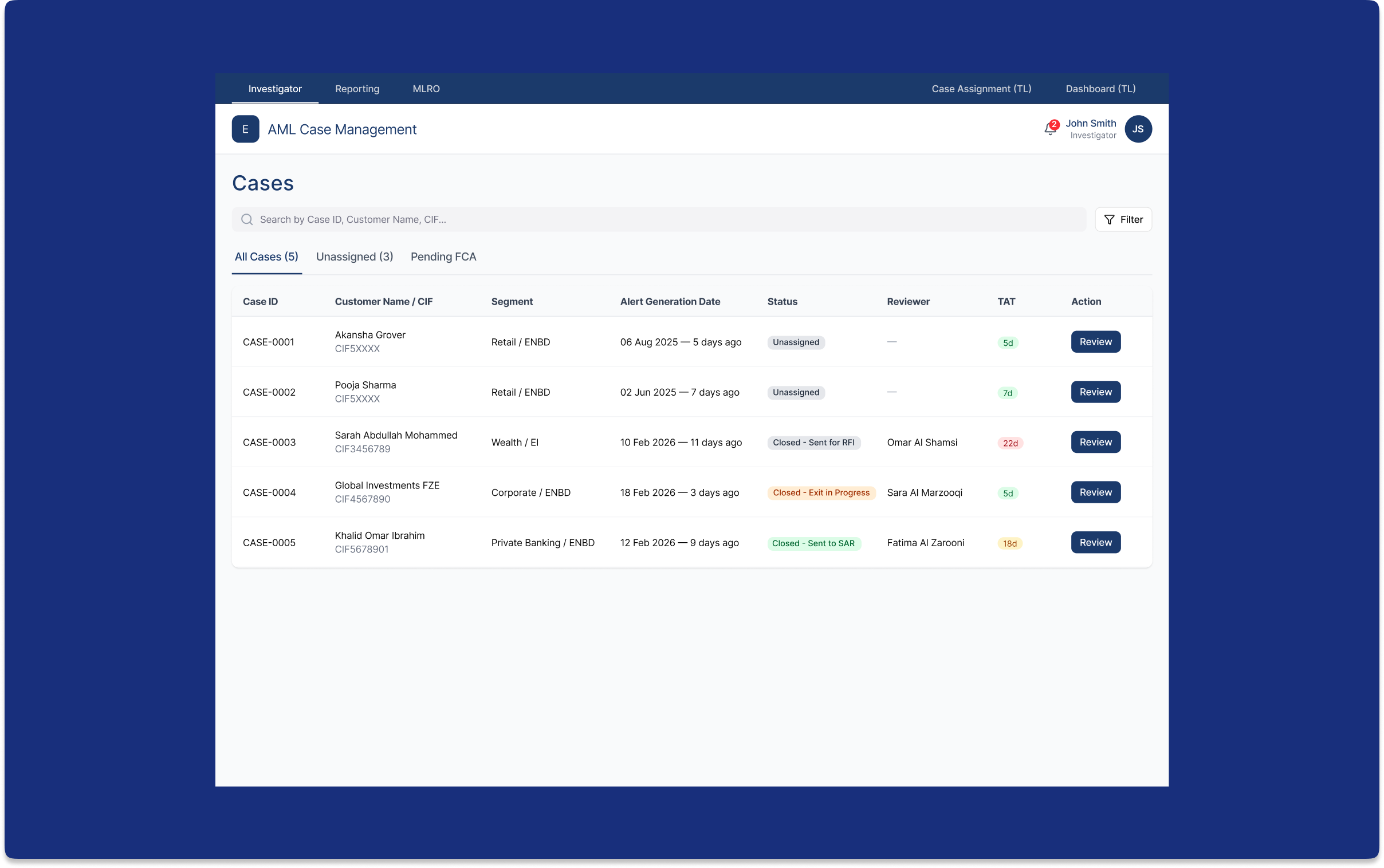
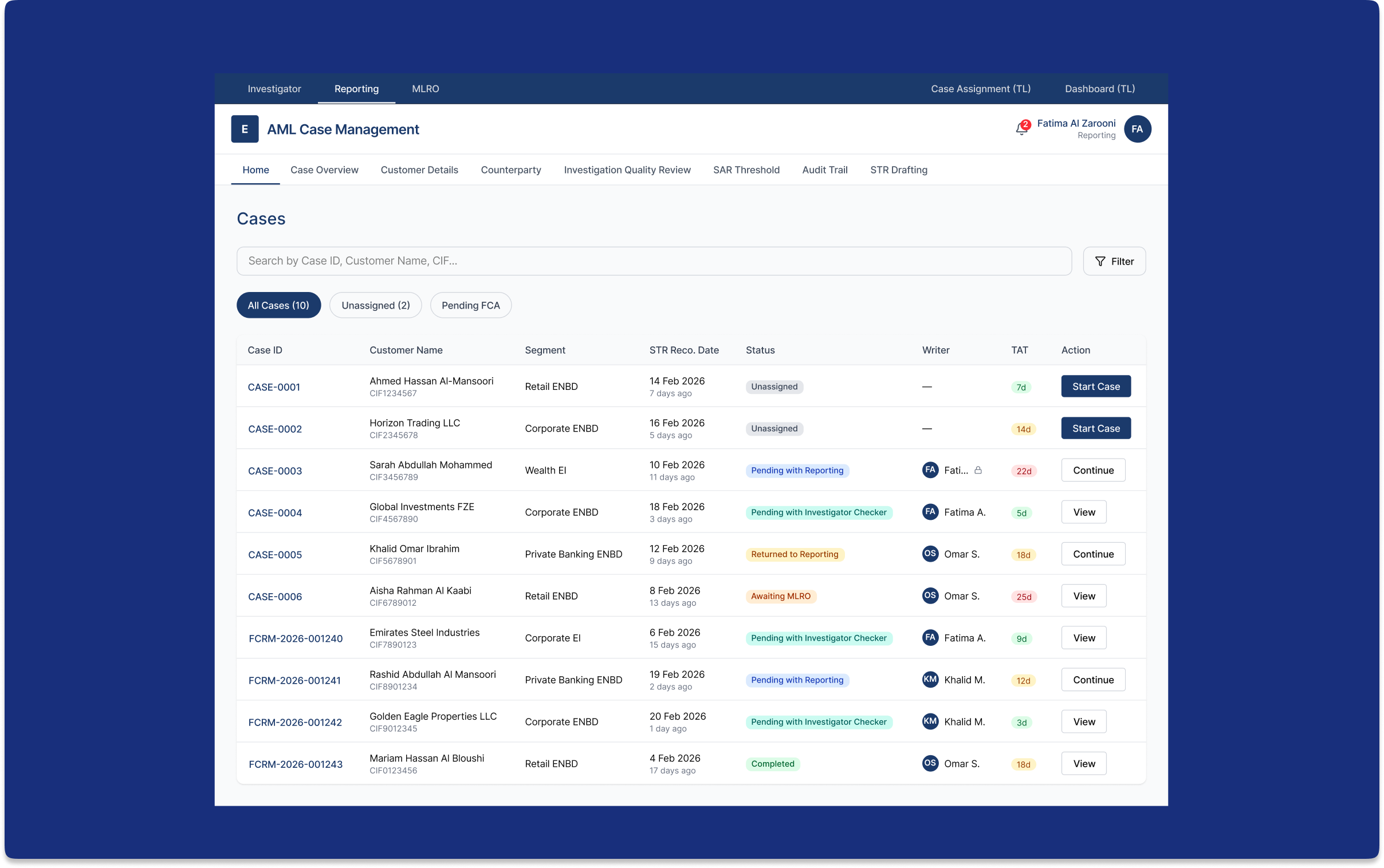
Same objective, four sets of software. Information fragmented, handoffs messy, no single place holding the truth about a case. Slow — and slow is expensive when the errors are legal ones.
The objective: one tool that unifies the whole process, first review to final decision.
3 · Figuring out a world I knew nothing about
I'd never worked in compliance. So I used AI to learn the domain — what AML is, what a SAR is, what an MLRO actually does — and then took a thousand questions to my product manager, who was patient enough to answer them.
We challenged each other, and we challenged the requirements. Every round of feedback from investigators, the reporting team and the MLRO changed what we thought we were building.
The questions that shaped it:
One tool solves the fragmentation. What else is possible now that everything's in one place?
Where does AI actually help each team? An investigator and an analyst need different things from it.
How much should the AI decide, and where does the human come back in?
What repetitive work can be delegated? Reading every document on a case, pulling the relevant facts together, summarising what's there.
4 · What we built
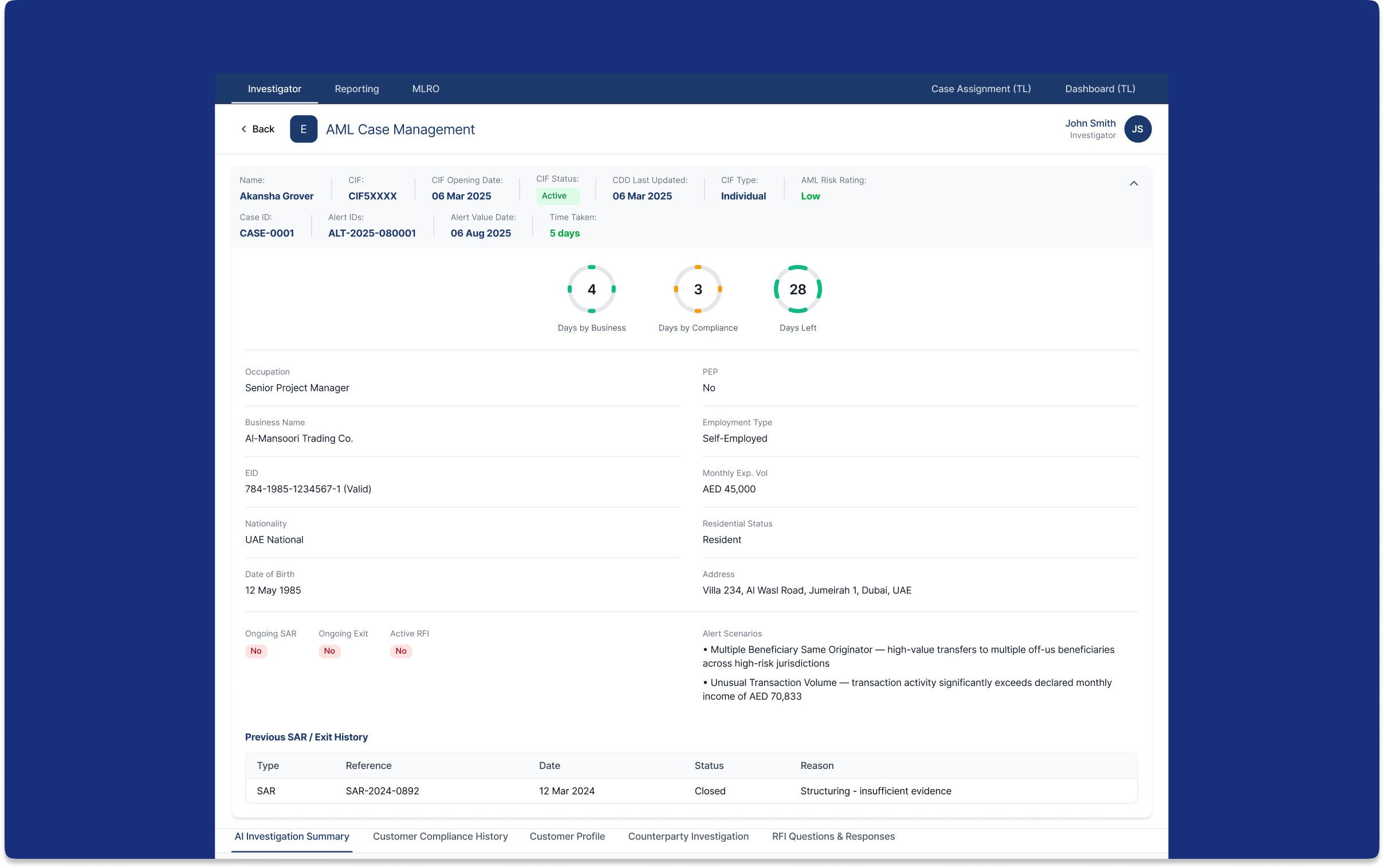
A single AML case management tool holding everything an investigator needs in one view — customer profile, transaction history, counterparty breakdown, previous SAR history, compliance checks. One screen instead of four systems.
On top of it, an AI layer that reads every document on a case and produces a summary, so the analyst starts from the facts rather than a pile of PDFs.
The AI proposes. The human decides.
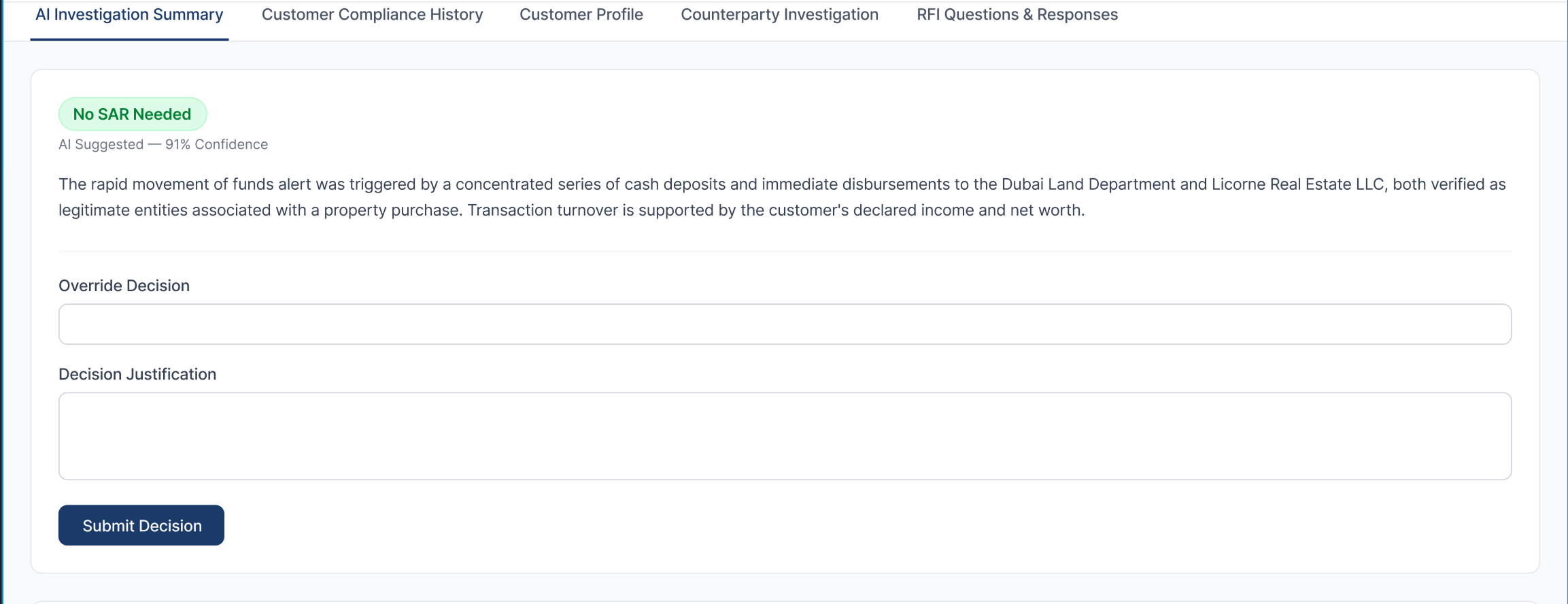
Three decisions made that real rather than a slogan:
It shows its confidence. The recommendation arrives as "No SAR Needed — AI suggested, 91% confidence." An investigator needs to know how much to trust a suggestion, not just what it says. A number does that; a verdict doesn't.
It shows its reasoning, not just its answer. Under every recommendation sits a "Why safe to close" panel — regular salary credits matching declared income, verified counterparties, transaction activity consistent with net worth. Four pieces of evidence, each checkable. An investigator can disagree with the logic rather than take the conclusion on faith.
Overriding requires a written justification. The investigator can reject the AI's call — but the field asking why is mandatory. The audit trail is produced by the design rather than bolted on, and in a function where every decision may be examined by a regulator, that matters more than speed.
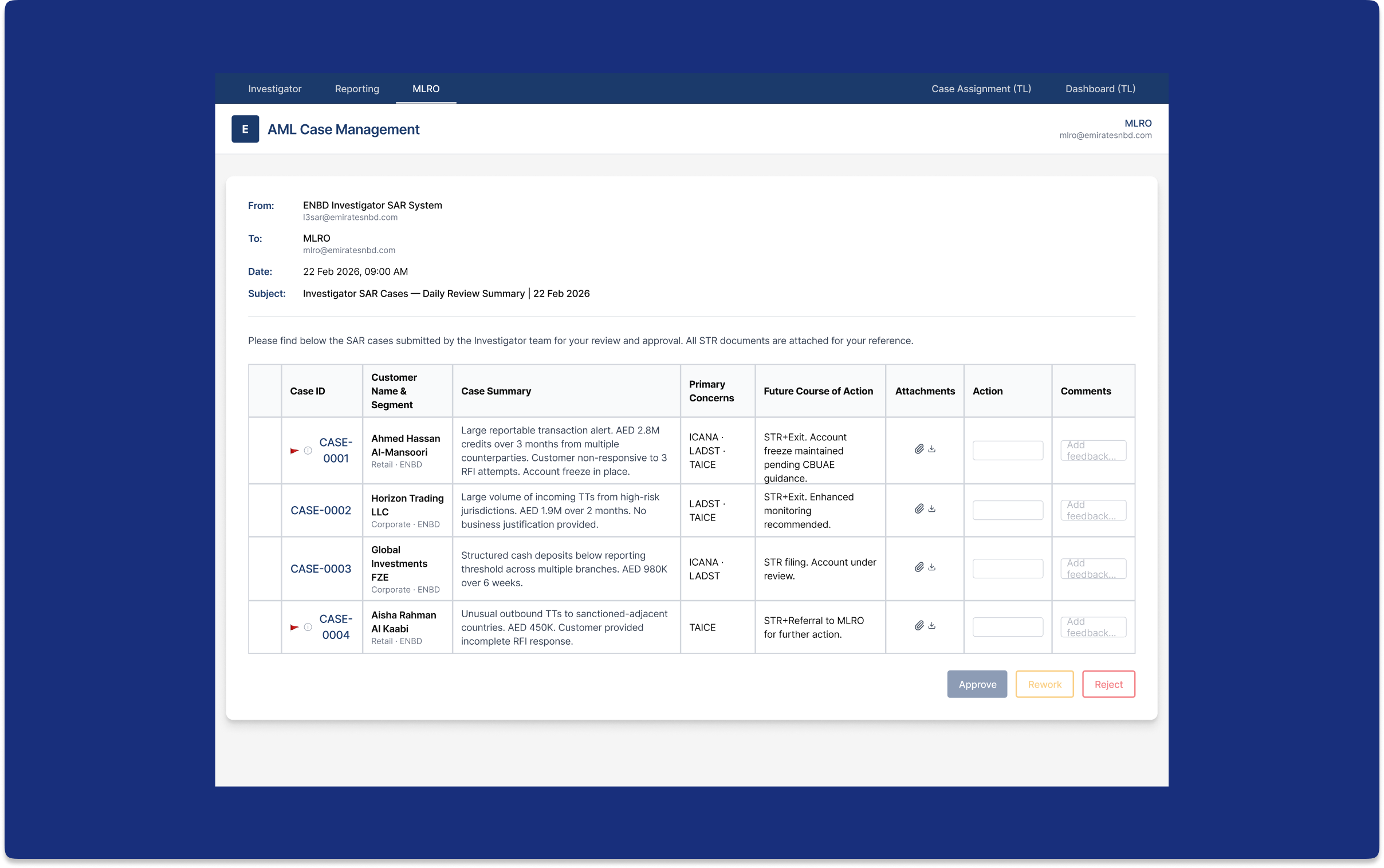
The AI also routes: resolve here, escalate to investigation, or send to the MLRO and on to the central bank.
Like giving a detective a brilliant assistant who does all the research and presents a verdict — but the detective always makes the final call.
5 · How it got built
Several rounds with compliance investigators, the reporting team, the MLRO and senior business stakeholders — each round changing requirements, each round meaning a rebuild. Prototyping with Claude and Figma Make made that survivable; new versions came back fast enough to keep pace with a brief that kept moving.
The prototype was endorsed for future implementation, directly influencing the compliance investigation roadmap.
6 · Reflection
In a way I was helping keep criminals from moving money through the bank, and designing for the right cause felt good.
But the reason I enjoyed this project so much was my product manager. He made it safe to be myself, ask a thousand questions, and challenge the requirements. That taught me something bigger than the project: human relationships are everything, and who you work with shapes the experience more than what you work on.